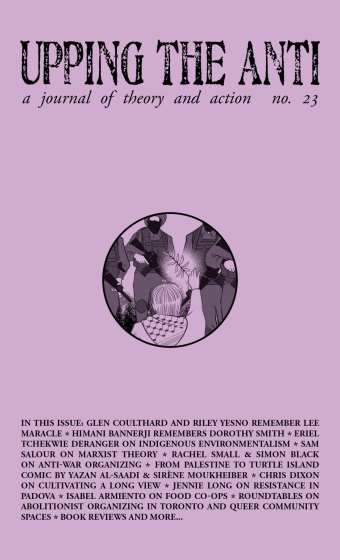
Upping the Anti is a radical journal of theory and action which provides a space to address and discuss unresolved questions and dynamics within the anti-capitalist, anti-oppression, and anti-imperialist politics of today’s radical left in Canada.

Upping the Anti #8


view larger image

Issue #8 of Upping the Anti is being launched in Toronto at the
Concord Cafe, 937 Bloor St. West (at Bloor and Ossington) on Friday May 8th, 2009.

If you would like to receive a hard copy of the journal or to distribute the journal in your community or through organizations that you are involved with, please email uppingtheanti@gmail.com so that we can add you to our list of local distributors. We are selling single copies for $10 including postage. If you want 5 or more copies for distribution, the journal is $5 per copy, and we'll cover the postage. Journal articles and PDF files will be uploaded to the website in a staggered process over the next few months.

Our mailing address where you can send your $10 in well concealed envelope for a copy of the journal is: Upping the Anti, 998 Bloor St. West, P.O. Box 10571, Toronto, Ontario, Canada M6H 4H9. You can also pay via PayPal or credit card. If you live in the US or elsewhere, please order our journal through AK Press as it costs us too much to mail it to you from Canada. Please continue reading this post for the full table of contents of this issue and the introduction to this issue.

The Arts of Living in Common

This talk by El Kilombo was given as part of an event at El Kilombo social center in Durham, North Carolina, titled "Art and Revolution," held on Februrary 19, 2009 with guest speakers Fred Moten and Robin D.G. Kelley. The event was part of El Kilombo's spring 2009 speaker series: "Things Unseen: Building Autonomy in a Time of Crisis."

The Arts of Living in Common
by El Kilombo Intergaláctico
I want to expand on the presentation that was given by Kilombo at our last event by briefly proposing an additional four points which we feel directly relate to tonight’s topic and which we hope will resonate with what Robyn Kelly and Fred Moten have already said. I will make sure to be brief so that everyone has an opportunity to participate in the Q&A that will immediately follow:

1) The Way of Viewing Change From Above: Exceptionality and Appear(ing) in the Given Field of the Visible.

Pro-Israel Lobby Alarmed by Growth of Boycott, Divestment Movement

Art Young

The movement to call Israel to account for its crimes against the Palestinian people is growing. It is “invading the mainstream discourse, becoming part of the constant and unrelenting drumbeat against Israel.” It could eventually threaten the existence of the Jewish state by undermining the support it receives from its strongest backer, the U. S. government. That was the message of alarm delivered by the Executive Director of the American Israel Public Affairs Committee, Howard Kohr, to the AIPAC Policy Conference on May 3.[1]

AIPAC is one of the principal organizations that lobby publicly on behalf of Israel in the United States, where it is an important influence on foreign policy. Among the 6,000 dignitaries who attended its policy conference were more than half of the members of the Senate and a third of the members of the House of Representatives. Featured speakers included Vice President Joe Biden, Senator John Kerry, former Speaker of the House Newt Gingrich, Israeli Prime Minister Benjamin Netanyahu and Israeli President Shimon Peres.

SOLIDARITY WITH TORONTO CITY WORKERS

Ontario Coalition Against Poverty
STANDS IN SOLIDARITY WITH TORONTO CITY WORKERS

The members of CUPE 416 and 79 who work for the City of Toronto
are now on strike. The business media has begun its inevitable campaign of
misinformation to produce the greatest possible backlash against these
workers. We are encouraged to focus on uncollected garbage and suspended
services but not, of course, to give any regard to the rights of public
sector workers or to think as working people about what is at stake in
this strike.

OCAP, as a matter of basic principle, stands in solidarity with
workers' struggles. We don't hate or blame workers who have been able to
win a living wage or support calls for them to be driven into poverty.
Rather, we want to see the poor provided with wages and incomes that raise
them out of poverty.

This strike occurs in a context that makes it especially important
for all of us that it end in victory and that the concessionary demands of
the 'progressive' Miller Administration be defeated. The Mayor defended
his shameful efforts to gut the collective agreements of City workers by
pointing to rising welfare caseloads brought on by the economic downturn.
What a disgusting statement. To pit City workers against those who are
being forced to turn to the wretched sub poverty pittance that welfare

Because intellectualism is for everyone and creativity is rebellious

Because intellectualism is for everyone and creativity is rebellious
By Tamara Pearson, from Z Net, June 20, 2009.

(Venezuela) -- Karl Marx lay down on the couch, poured some cheap sherry into a glass jar, and balanced it carefully on his bare chest. A Nigerian oil worker sipped on palm wine as President Yar'Adua spoke of nationalism and country as though blowing through a straw. A young Swiss housewife poured herself a shot of whiskey. A Venezuelan writer and community council representative walked into The Widow, and asked for a beer and pastel. And then they all wondered. Really, really, is it possible to collectively and democratically make a new kind of world?

~

The first essay I wrote at university started off with dialogue. My teacher, an ex communist party member, gave me a distinction for the "thorough research" but told me to refer to the university first year student guide about how to write an essay. Essays do not contain dialogue or narrative. They are clearly structured arguments with a beginning that summarises the ...blah blah. I did not put dialogue into an essay again. To do so, was to lose marks. To lose marks was to possibly fail a course and increase the debt I still owe the Australian government.

~

New York City: Second Encuentro for Humanity and Against Displacement.

Below is the report from Movement for Justice in El Barrio on their Second Encuentro for Humanity and Against Displacement. I'll link to more reports on the Encuentro at this post as they come out...

To our sisters and brothers of The People’s Front in Defense of the Land:
To our Zapatista sisters and brothers:
To our compañer@s, adherents of the Other Campaign in Mexico:
To our compañer@s adherents of the Zezta Internazional:
To our compañer@s adherents of the International Campaign in Defense of El Barrio and our allies from all over the world:

From the Other New York and zapatista East Harlem, which is not for sale and does not forget the prisoners of Atenco, receive a greeting from the women, men, and children, those socially marginalized and globally excluded, who belong to The Other Campaign New York, Movement for Justice in El Barrio:

Canada Park: Dedication Site Built From Razed Palestinian Homes

June 19, 2009

By Jonathan Cook, June 19, 2009.

Canada's chief diplomat in Israel has been honoured at an Israeli public park -- built on occupied Palestinian land in violation of international law -- as one of the donors who helped establish the park on the ruins of three Palestinian villages.

Jon Allen, Canada's ambassador to Israel, is among several hundred Canadian Jews who have been commemorated at a dedication site. A plaque bearing Mr Allen's name is attached to a stone wall constructed from the rubble of Palestinian homes razed by the Israeli army.

Mr Allen, who is identified as a donor along with his parents and siblings, has refused to talk about his involvement with the park.

Rodney Moore, a Canadian government spokesman, said the 58-year-old ambassador had not made a personal donation and that his name had been included as a benefactor when his parents gave their contribution. It is unclear whether he or they knew that the park was to be built on Palestinian land.

Canada Park, which is in an area of the West Bank that juts into Israel north of Jerusalem, was founded in the early 1970s following Israel's occupation of the West Bank in the 1967 war. It is hugely popular for walks and picnics with the Israeli public, most of whom are unaware they are in Palestinian territory that is officially a "closed military zone".

Toronto: Queers Against Israeli Apartheid is calling on all allies to support us by marching with us in Pride!

As you may know, after our very successful May 23 forum at Buddies, "Coming
Out Against Apartheid," QuAIA has come under attack from B'nai Brith, the
Canadian Jewish Congress, the National Post, and the Toronto Sun, all trying
to ban us from Pride. El-Farouk Khaki, Pride Grand Marshal, has been singled
out for attack as a gay Muslim. Straight pro-Israel lobbyists like Bernie
Farber have been lecturing the queer community on what Pride is supposed to
be about.

QuAIA has not backed down, and neither has Pride. The response from the
queer community and the queer press has been overwhelmingly supportive.

Your presence and support are needed to *KEEP PRIDE POLITICAL! *Here's how
you can help:

*March with Queers Against Israeli Apartheid at Pride*
This year we are going to have the biggest anti-apartheid contingent EVER in
the Pride parade, and we want you to march with us!

Joining us in the contingent will be members of the Simon Nkoli
Anti-Apartheid Committee, the Toronto gay activist group that fought against
South African apartheid. They’ll even have the banner they carried in the
parade in the 1980s.

To join us in the Pride parade, meet us at the corner of Bloor and Church
Streets on Sunday, June 28th at 2:00 p.m. We will send our exact entry
location closer to the date.

OPEN LETTER TO THE CANADIAN GOVERNMENT AND SOLIDARITY MESSAGE TO THE HAUDENAUSAUNEE WOMEN OF AKWESASNE, AND TYENDINAGA

We, women of the Montreal-based, March 8th Coordination and Action
Committee of Women of Diverse Origins (WDO) express our profound
solidarity with the Haudenausaunee women and their communities as they
struggle to stop the ongoing annexation and illegal occupation of
their un-surrendered lands. We extend our deepest respect to the
Haudenausaunee people of Akwesasne who have courageously defied the
Harper government's plan to arm the Canadian Border Services Agency
(CBSA) border guards at the Kahwehnoke border crossing (Cornwall
Island).

We ardently denounce the brutal attack and vicious arrests of members
of the Tyendinaga Mohawk community on June 12, 2009, who were standing
in solidarity with the community of Akwesasne by blocking access to
the local Skyway bridge in Southern Ontario to demand that the Federal
Government enter into meaningful discussions with the community of
Akwesasne.

The Canadian state has been built on violence against Onkwehonwe women
and their families -- sexual violence, genocide and on-going colonial
repression. Harassment by border guards against Akwesasne community
members is only a recent form of aggression in a long history of
colonialism. Hundreds of complaints have been filed against the CBSA
for incidents like conducting a cavity search on a teenager,
subjecting a pregnant woman to repeated x-rays and interrogating

STONEWALL was a riot

By Michael Bronski, Source: The Guide , June 10, 2009.

It was a just another hot, sticky night toward the end of June.

The streets of Greenwich Village were filled with cruising men, displaced street youth, drug dealers and random musicians trying to make a few bucks from small audiences. But when New York City's Finest raided the Stonewall Inn in the early hours of June 28, something extraordinary happened.

Police raids on the city's gay bars took place all the time, but that night was different. That night people fought back. They were angry. Maybe it was because gay icon Judy Garland died two days earlier, or because the heat got to everyone. Or it just might have been that gays couldn't take it any longer. But that evening, and for the next two evenings, Christopher Street was filled with gays, as well as the neighborhood's more motley denizens, heckling, taunting, and at times engaging in physical exchanges with the police. It was the birth of a new era of queer life. But exactly what that new era was is up for debate.

OPP Assault on Mohawks this Morning: Mohawk Women re-take Skyway Bridge

OPP Assault on Mohawks this Morning: Mohawk Women re-take Skyway Bridge

(Friday, June 12, 2009) A brutal police takedown of Mohawks from
Tyendinaga on the Skyway Bridge by the OPP Public Order Unit took
place at 6:30 am this morning.

Following the arrests of Mohawks by the OPP, who cleared the Skyway
Bridge of Tyendinaga Mohawks standing in support of the community of
Akwesasne, women from the Tyendinaga community have re-taken the
bridge

Currently, the women are holding the bridge, while it appears the OPP
is contemplating whether or not to launch a second assault. There are
police helicopters flying overheard, as well as OPP boats in the bay
next to the bridge, and police cars on the roads surrounding the
bridge.

BACKGROUND:

Tyendinaga Answers Akwesasne's Call, Shuts Down Skyway Bridge,
Tyendinaga Mohawk Territory

(Sunday, June 7, 2009) The community of Akwesasne has been living
without the freedom of mobility for one week. People have been cut
off from family and friends, barred from access to elder relatives in
need of care, unable to get to work and hundreds of children have had
their school year disrupted.

It is no secret that there are significant tensions between the
community of Akwesasne and Canadian Border Services Agency. Hundred
of complaints have been filed for incidents like conducting a cavity

A Rainbow Flag Over Habana

Marina Sitrin

We are on a main city block early Saturday morning. People gathering are high spirited, almost giddy. As people begin to form a line I
exhale deeply, imagining it is just one of many lines that are the Cuban reality. This line, however, is different. This line begins to shift, snake, jump and dance. This is a conga line. There are hundreds of us, perhaps even a thousand, and we are dancing in a conga line down one of the most central streets in Havana. And we are not just some random group of people, we are a group of lesbians, gay men, transvestites, transsexuals and bisexuals, along with heterosexual friends and sometimes even families, all gathering for the International Day Against Homophobia. For over a week activities have been taking place throughout Havana, as well as in a few provinces in the country to educate about sexual diversity, and, to celebrate it.

While the events that have been taking place have the feeling of Gay Pride, they are also Cuba’s version, meaning it is organized for people, not by the people. But this is Cuba. A place where all passions cannot, and are not, controlled from above. I felt the contradictions that are Cuba surface in a palpable way on the Saturday of the conga line. I saw some of the things I love most about this contradictory island, and some of the things I like least.

The Struggle Has Its Own Dynamic: The Professors’ Strike at the Université du Québec à Montréal

David Mandel

The seven-week strike of professors at the Université du Québec in Montréal (UQAM) ended on April 24, 2009 in a significant, if partial, victory. It is, unfortunately, a rare event in contemporary Quebec, and, for that matter, in North-America. It is therefore worth looking into this conflict to see what lessons it might offer of use to other unions.

Unfavourable Context
Before presenting the results of the strike, it is important to note that the context leading up to it did not at all appear favourable to a strike, even less to a victorious outcome.

Despite their public image as critical thinkers, university professors (with significant exceptions) are a socially rather conformist group in relation to the dominant ideology. The intellectual life of a society is very much influenced by the balance of class forces, and that balance in Quebec has shifted strongly in favour of the dominant class over the past quarter of a century. Rare are the professors who adopt dissident positions in relation to the established order or who show an active commitment to the interests and struggles of the popular classes. In addition, the very occupation of university professor, at least the way it is structured in our society, tends to encourage individualism, competition, the all-out quest for personal recognition.

Obama's Cairo Speech

Gilbert Achcar

Barack Obama's speech in Cairo on the 4th of June 2009 definitely lived up
to expectations -- provided we agree on what could have been expected.

With regard to the form, Obama fully lived up to his role as the new black
and human face of America in its relation with the rest of the world in
general, and with the Muslim world in particular. He respected the
specifications of his mission, seeking to repair the huge damage caused to
America's image and "soft power" by the previous administration of George
W. Bush. The world witnessed a spectacular attempt at seducing the Muslim
world -- its youth in particular.

The president's assets were intensively used: the colour of his skin, his
Muslim paternal background, his early opposition to the invasion of Iraq
and, last but not least, his Rooseveltian posture suited to our times of
global economic crisis. The speech was very obviously inspired from FDR's
famous "Four Freedoms" speech of the 6th of June 1941: the language of
peace and disarmament, i.e. freedom from fear; freedom of thought; and
religious freedom. Only Roosevelt's "freedom from want" was missing, a
testimony to the extent to which this concept is embarrassing for
governments that are temporarily resorting to "Keynesian" tools only in
order to rescue the neoliberal economic system.

Pride Toronto Stands Its Ground Against Pro-Israel Lobbyists

By Andrew Brett, Rabble. May 30, 2009.

Toronto's gay pride festival refuses to ban pro-Palestinian contingent despite threats to funding.

Earlier this week, I wrote about pro-Israel lobbyists threatening corporate and government funding for Toronto’s gay pride unless the festival banned a pro-Palestinian contingent from the parade.

On May 27, the National Post erroneously reported that Pride Toronto had banned the “Queers Against Israeli Apartheid” contingent. In fact, no such decision had been made, and Pride Toronto issued a public clarification the next day to say that no groups had been banned.

The premier corporate sponsor of Pride also disputed the claim made in the B’nai Brith newspaper that they had asked for the contingent to be banned. “We know that political issues may arise during Pride,” said Gregory Harrison of TD Bank Financial Group. He said they have no problem with any group’s presence, as long as they don’t violate hate laws.

The tactic of trying to censor the group appears to have backfired for pro-Israel lobbyists. In response to the rumour that the pro-Palestinian contingent would be banned from the parade, outrage poured in from across the queer community.

Freedom of Expression and Palestine Activism

Rafeef Ziadah

Enormous resources have been marshaled by conservative and Zionist organizations in an attempt to silence criticism of the Canadian government’s unwavering support for Israel. The first few months of 2009 have seen a concerted campaign to shut down Palestine advocacy in Canada. Such examples include:

cutting funding to the Canadian Arab Federation (CAF) due to the organization’s outspoken criticism of the government during the war in Gaza;
banning posters for the annual Israeli Apartheid Week (IAW) in several Ontario university campuses; and
a smear campaign against the Ontario branch of the Canadian Union of Public Employees (CUPE) for daring to discuss the issue of an academic boycott of Israel.

This is not an exhaustive list. The Canadian government also banned George Galloway, who was scheduled to speak about his trip to Gaza, in the same period. Artist Reena Katz was recently “disassociated” from the Koffler Centre of the Arts in Toronto, which was exhibiting her artistic work. Koffler “disassociated” with Katz for her activities with Israeli Apartheid Week (IAW): her exhibit was on the Toronto Jewish Community, not related to Palestine at all.

Queers Against Israeli Apartheid

*Coming Out Against Apartheid*
20 Years of Queer Resistance from South Africa to Palestine

May 23rd 2009
6:30pm
Buddies in Bad Times Theatre
12 Alexander Street

Admission is Free. Everyone is welcome.

1986: Queer people in Toronto united in the Simon Nkoli Anti-Apartheid
Committee (SNAAC) to fight for justice in South Africa.

2009: Another struggle against apartheid is building throughout the world.
Queer people are joining the international call to name Israel’s occupation
of Palestine apartheid.

Israel has now begun to frame itself as a tolerant, queer-positive
democracy. This can never be reality under Occupation.

*Join Queers Against Israeli Apartheid on May 23 for an evening to reignite
Toronto’s queer community in the fight against apartheid. *

This event will feature:

*Tim McCaskell.* *Tim was a member of the Simon Nkoli Anti-apartheid
Committee, which did queer solidarity with anti-apartheid struggles in the
1980s. He was also a member of the Body Politic Collective, the
ground-breaking Toronto radical queer newspaper; an organizer of the 1981
bath raids protest and Right to Privacy Committee; co-founder of AIDS Action
Now; and has been an anti-racist activist for several decades. Tim is also
one of the subjects of John Greyson's acclaimed new documentary opera, *Fig
Trees*.*

Tamil Protests: Resistance in the Face of Genocide

Eelam War IV: Finishing the work of the tsunami

Justin Podur, May 16/09

The Sri Lankan military now (May 16/09) controls virtually all of the
territory that was once controlled by the Tamil Tiger (Liberation Tigers
of Tamil Eelam, or LTTE) insurgents. The Tigers have suffered military
defeat after military defeat over the past few years. Their leaders and
remaining soldiers - along with 50-100,000 Tamil civilians - are
confined to a small strip of territory called a “no-fire zone” in the
North-East of the country, surrounded by several divisions of the Sri
Lankan army. Thousands of other Tamil civilians have been evacuated to
Internally Displaced Persons (IDP) camps that are under total control of
the Army. The surrounded pocket where the remaining Tigers are trapped
is itself under artillery and other attack by the Army, whose operations
have killed thousands of civilians in the past few weeks and months. On
May 11, the United Nations Secretary General condemned the Sri Lankan
Army for using heavy
weapons in the zone and the LTTE for “reckless disrespect for the safety
of civilians”, which “has led to thousands of people remaining trapped
in the area”. The UN suggests the following way forward: The LTTE is to

Why Is There Rampant Famine In The 21st Century And How Can It Be Eradicated?

By Eric Toussaint and Damien Millet, May 11, 2009.

How can we explain the fact that famine still exists in the 21st century? One person in seven on this planet is permanently hungry.

The causes are well known: a profound injustice in the distribution of wealth and the monopolizing of land by a small minority of large landowners. According to the FAO[1], 963 million people were suffering from famine in 2008. Paradoxically, these people mainly live in rural areas. They are generally farmers who do not own land or do not own enough, and are without the means to cultivate it effectively.

What caused the food crisis of 2007-2008?

It is important to emphasize that in 2007-2008, the number of people suffering from hunger increased by 140 million. This marked increase is due to the explosion of food prices[2]. In several countries retail food prices increased by as much as 50%, or even more.

Why such an increase? To answer this question, it is important to understand what has been happening over the past three years. Only then can alternative, appropriate policies be implemented.

Letter from the FPDT in Atenco to the Zapatistas in Chiapas

LETTER FROM THE PEOPLES’ FRONT IN DEFENSE OF THE LAND-ATENCO
TO THE ZAPATISTA ARMY OF NATIONAL LIBERATION

San Salvador Atenco, May 3, 2009.

TO THE CCRI-CG OF THE EZLN.
TO THE SIXTH COMMISSION.
TO THE GOOD GOVERNMENT COUNCILS.
TO THE BASES OF SUPPORT.
TO THE ZAPATISTA MOVEMENT.

SISTERS AND BROTHERS.

When everything began, a lot of people said, “You can’t beat the government.” Back in 2001, when they condemned us to extermination and to the loss of our history and identity for the sake of building an airport, we knew things shouldn’t be the way they were. We knew we had to struggle to overcome the mentality that tells us “that’s the way things are and there’s nothing you can do about it.”

Demanding the Impossible: Struggles for the Future of Post-Secondary Education

Tyler Shipley

There is growing acknowledgement emerging from student and faculty associations across Canada that there is a crisis in post-secondary education and a need for real change in the structure of university funding. This has manifested as a proliferation of student and worker unrest across the country and, indeed, the world; in 2008 and early 2009, there were dozens of university strikes and occupations across the world marked both by broader ideological challenges to the prevailing social order as well as increased repression from campus and state authorities. In Montreal, a protracted faculty strike was supported by an active student movement at UQAM and ended in an impressive victory. Meanwhile, student movements like “Opiskelijatoiminta” in Helsinki, and occupations of university space at NYU and the New School in New York have drawn inspiration from the sometimes violent demonstrations in universities across France and countless other actions in Italy, Greece, India and elsewhere.

The Smearjob On the Durban World Conference Against Racism

Sid Shniad

In 2001, the United Nations convened the World Conference Against Racism (WCAR) in Durban, South Africa, to deal with a range of issues related to racism and its legacies, including the Trans-Atlantic slave trade, the appropriation of the land and resources of the world's indigenous peoples, and the human rights of the Palestinians.

The government of Israel responded to the anti-Semitic actions of a few marginal NGOs which participated in Durban by branding the entire WCAR – widely seen as a high water mark in the international battle against racism – as an anti-Semitic “hatefest.” This became the pretext for Israel and its allies to walk out of the conference in an attempt to prevent Israel's behaviour vis-à-vis the Palestinians as well as other vitally important matters from being addressed.

Raise your voices against repressions by the state of Chiapas, Mexico

May 4th, 2009

San Cristóbal de las Casas, Chiapas, México

To members of the other campaign both national and international

To the alternative national and international media

Sisters and brothers in national and international resistance movements

Cordial greetings! We are writing you today to ask for your strong and committed support in action and solidarity in the search for justice for 8 activists unjustly and illegally imprisoned, tortured, badly treated, stigmatized by the media, and now awaiting possible incarceration for false accusations. Presently these activists, Jerónimo Gómez Saragos, Antonio Gómez Saragos, Miguel Demeza Jiménez, Sebastián Demeza Deara, Pedro Demeza Deara y Jerónimo Moreno Deara, members of the Other Campaign and residents of Ejido San Sebastián Bachajón, in the municipality of Chilón, detained on April 13th, 2009; as well as Alfredo Gómez Moreno y Miguel Vázquez Moreno, who is a a member of the Zapatistas, and was detained on the 17the and18th of April in the prison “El Amate” CERESS 14 in Cintalapa, Chiapas, Mexico. In the course of the next 4 days, ending on Friday, May 8th, the state will decide whether these activists are innocent and free from the crimes which they are falsely accused or whether they will be incorporated in the corruption of this government and imprisoned.

Anti-capitalism, Climate Change, and Copenhagen

Anti-capitalism, Climate Change, and Copenhagen
By Cynthia Kaufman, from Climate and Capitalism, May 6, 2009.

Given the world-wide financial and economic meltdown, and the consequent delegitimation of capitalism as a whole, there has been no time in the past 50 years like the present for the spreading of anti-capitalist analysis and politics.

The part played by climate change at this critical juncture could be a powerful spur to anti-capitalist activity. And yet, if anti-capitalist agents make the wrong choices at this moment, action around climate change could be the undoing of a movement about to be born. All of this will played out in a chapter of world history being written presently as the world builds toward the international climate negotiations set to take place in Copenhagen in December of 2009.

The global capitalist system is the one force most responsible for the climate crisis. An economy predicated on allowing those with resources to use them in ways that maximize profits, along with the political structures set up to facilitate that profit making, have led to a system of production that uses tremendous amounts of resources and is accountable to no one. This unaccountable system presently runs on fuels that are destabilizing the climate system within which human society has emerged.

Interview with the Revolutionary Association of the Women of Afghanistan

By Ian Sinclair, Peace News, May 6, 2009.

Established in 1977, the Revolutionary Association of the Women of Afghanistan (RAWA) is an independent women's organisation fighting for human rights and social justice in Afghanistan. RAWA opposed the Soviet invasion and occupation of Afghanistan from 1979-89, aswell as the subsequent Mujahaden and Taliban governments, running underground schools for Afghan girls, publishing a journal and setting up humanitarian projects.

Mariam Rawi a member of RAWA's foreign relations committee, answer's Peace News's questions about the current US-led occupation of Afghanistan.

1) In 2001 President Bush claimed the United States invaded Afghanistan to fight for "progress and pluralism, tolerance and freedom". Why does RAWA think the United States invaded and continues to occupy Afghanistan?

The Lessons of Gaza 2009

May 05, 2009 By Bashir Abu-Manneh, May 5, 2009, Against the Current

FIRST THE NUMBERS:

"1285 Palestinians killed, mostly civilians, including 167 civil police officers. 4336 Palestinians wounded, mostly civilians. Two political leaders of Hamas assassinated, Nizar Rayan and Said Siam, in bombs that flattened their home and also killed many of their family members and neighbors. Tens of thousands of people forced to abandon their homes: 2400 houses completely destroyed, and 17,000 semi-destroyed or damaged. Tens of mosques, public civilian facilities, police stations, and media, health, and educational institutions either completely or partially destroyed. 121 industrial and commercial workshops destroyed and at least 200 others damaged."[1]

Israel's army, the fourth most powerful in the world, surrounded and attacked by air, land, and sea a defenseless population that it has intensively besieged since 2007, occupied for the last 42 years, and expelled and dispossessed for the last 60 years. For 22 days of relentless round-the-clock bombing, 1.5 million Gazans were terrorized: nobody and nowhere was safe in Gaza (as the UN's John Ging stated during the assault).

Behind the Afghan Propaganda

By Anthony Fenton, Asia Times, May 4, 2009.

Invisible History: Afghanistan's Untold Story by Paul Fitzgerald and Elizabeth Gould

Nearly 30 years after their first foray into the land-locked buffer state, married couple and journalist-historians Paul Fitzgerald and Elizabeth Gould could not have chosen a more appropriate time to publish their comprehensive Invisible History: Afghanistan's Untold Story.

Having taken a back seat to Iraq since the drumbeat for war began in the autumn of 2002, the ongoing escalation of the United States-North Atlantic Treaty Organization (NATO) counter-insurgency war and occupation have made "AfPak" the center of sustained US media attention for the first time since "shock and awe" temporarily drove the Taliban underground in October 2001.

A chronically disinformed US public should leap at the chance to familiarize themselves with an honest overview of their country's historically scandalous involvement in the region.

Migrant workers speak out and community rallies

Migrant workers speak out and community rallies
from UFCW Canada, May 4, 2009.

Migrant workers from across Canada gathered on May 2 to celebrate May Day, the international day of workers' struggle, and to speak about the realities of living and working in Canada as temporary and precarious labourers in the context of the economic crisis and the health concerns raised by the swine flu outbreak.

Under the Harper Conservative government, the Temporary Foreign Worker Program has expanded exponentially with over 200,000 TFWs entering the Canadian workforce each year as live-in-caregivers, agriculture workers, manufacturing workers, construction workers, and service and hospitality workers.

"The shift from immigrants as permanent residents with access to equal legal rights and a path to citizenship, to migrant workers who have precarious immigration status and limited legal rights, means creating a perpetually vulnerable workforce," says UFCW Canada National President Wayne Hanley.

How “The NAFTA Flu” Exploded

Smithfield Farms Fled US Environmental Laws to Open a Gigantic Pig Farm in Mexico, and All We Got Was this Lousy Swine Flu

By Al Giordano, Special to The Narco News Bulletin, April 29, 2009

US and Mexico authorities claim that neither knew about the “swine flu” outbreak until April 24. But after hundreds of residents of a town in Veracruz, Mexico, came down with its symptoms, the story had already hit the Mexican national press by April 5. The daily La Jornada reported:

Clouds of flies emanate from the rusty lagoons where the Carroll Ranches business tosses the fecal wastes of its pig farms, and the open-air contamination is already generating an epidemic of respiratory infections in the town of La Gloria, in the Perote Valley, according to Town Administrator Bertha Crisóstomo López.

The town has 3,000 inhabitants, hundreds of whom reported severe flu symptoms in March.

CNN’s Dr. Sanjay Gupta, reporting from Mexico, has identified a La Gloria child who contracted the first case of identified “swine flu” in February as “patient zero,” five-year-old Edgar Hernández, now a survivor of the disease.

Canadian Foreign Policy

A review of Yves Engler's "Black Book of Canadian Foreign Policy"

By Joe Emersberger, May 3, 2009.

In 2005, Yves Engler gave talks all over Canada to promote a book (co-authored with Anthony Fenton) that exposed Canada's criminal role in Haiti. Engler was never completely satisfied with his answer to a question that constantly came up during those talks:

"Why did Canada help overthrow Haiti's elected government in 2004?...Most people had difficulty understanding why their country - and the U.S. to some extent - would intervene in a country so poor, so seemingly marginal to world affairs. Why would they bother?"

He felt compelled to thoroughly research Canada's track record around the world. I've struggled with this question about Haiti myself, but half way through Engler's new book, "The Black Book of Canadian Foreign Policy", I felt silly for struggling. Canada has always behaved reprehensibly - even when it has had little direct incentive to do so.

Engler's book is written in a concise, straightforward style that mostly lets the meticulously referenced facts speak for themselves.

What follows does not even mention what Engler reveals about Canada's role in Venezuela, Nicaragua, East Timor and other countries. It is a mere sampling of what he uncovered.

The Caribbean

Syndicate content